


Compare electrical contracting costs by checking whether each quotation covers the same equipment specification, installation route, testing obligations and access conditions. Record exclusions and assumptions before ranking offers. An overall total cannot explain whether one bidder has omitted work that another has included.
For procurement teams and building owners in Riyadh, the practical task is to establish a common enquiry package and obtain written responses against it. The comparison below focuses on scope and evidence. It contains no market rates or electrical work procedures; qualified project specialists confirm the design, verification requirements and arrangements for interrupting services.
Establish a Common Basis for Every Quote
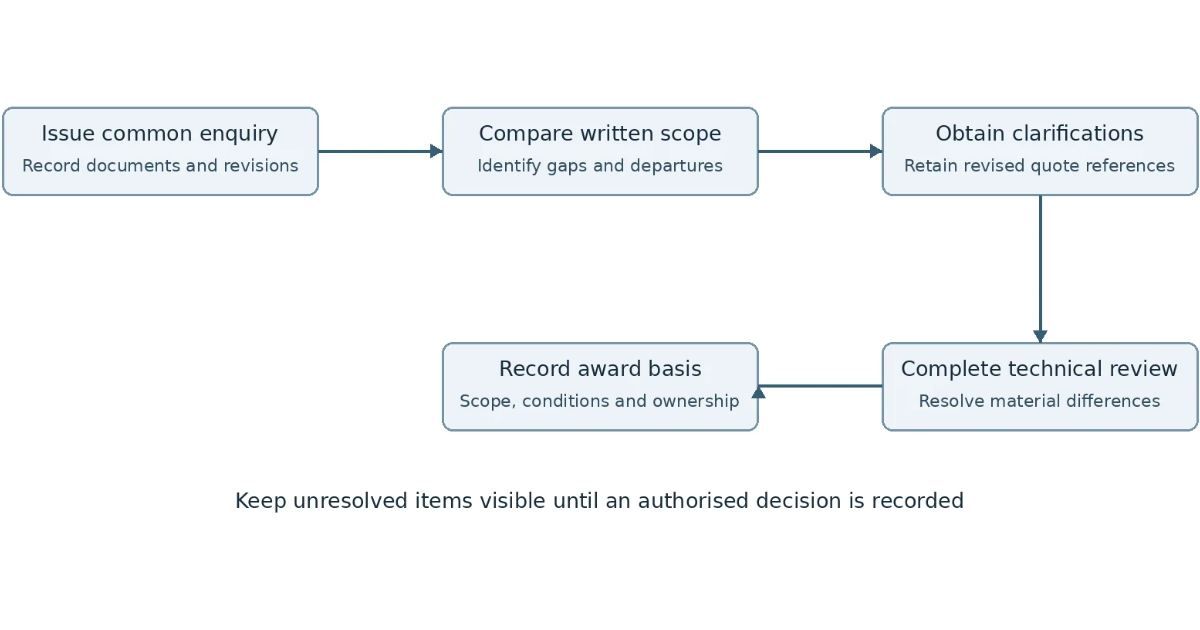
Issue the same document register to every bidder. Include the available design drawings, equipment and circuit schedules, specifications, bill of quantities and site information. Identify revisions and the design stage. Record tender clarifications so later responses can be traced to the same requirements.
Define whether the appointment includes design, installation against a consultant’s design, or specific delegated design. Ask the electrical consultant to confirm applicable codes, standards and approvals for this project. Separate preparation of submissions, technical review, authority coordination and client acceptance rather than treating them as one approval.
Describe existing installations, retained equipment and uncertain conditions. Ask bidders to identify what they have verified and what requires a survey. Include working hours, occupied areas, delivery restrictions and the proposed programme. These project conditions provide a stronger comparison basis than assumptions about city-wide labour costs or imported-material quality.
For the wider office project, the guide to fit-out budgeting and scope boundaries helps identify items carried in other packages.
Compare Equipment Specifications and Departures
Request a proposed equipment schedule with manufacturer, model and supporting technical data. Terms such as “approved brand” or “equivalent specification” need identifiable evidence. Compare the offered configuration, not only the brand: accessories, connections, controls and supporting documentation may differ.
Check the Offered Configuration
Have the electrical reviewer identify the characteristics relevant to each item. These may include rated duties, protective characteristics, enclosure requirements and compatibility with the designed system. Procurement should obtain the evidence and record the reviewer’s decision, rather than select ratings or protection settings independently.
| Comparison Field | Evidence to Request | Decision to Retain |
|---|---|---|
| Equipment identity | Manufacturer, model and dated datasheet. | Which exact configuration is offered? |
| Specified characteristics | Response against the relevant equipment schedule and specification. | Does the technical reviewer accept the stated compliance? |
| Accessories and interfaces | Included accessories, connections, controls and supporting items. | What is excluded or supplied by another party? |
| Alternative proposal | Separate departure statement and supporting technical information. | Is it accepted, rejected or awaiting clarification? |
Review Substitutions Explicitly
Keep the base compliant offer separate from alternatives where the enquiry requires it. Ask the bidder to explain each departure and its effect on installation, coordination, verification, delivery and warranty. A suggested alternative is not accepted simply because it appears in a quotation. Retain the authorised response and update affected schedules.
Check Cable Routes and Installation Boundaries
Ask which drawings, route assumptions and measurement basis support cable and containment quantities. Distinguish confirmed routes from provisional allowances. Two offers using different routes may include different lengths, supports, access arrangements and reinstatement work, even when they name the same equipment.
Compare responsibility for cable containment, fixings, supports, terminations, identification and connections. Clarify penetrations, fire stopping, access panels, ceiling opening, finishes protection and making good where relevant. Check that interfaces with other trades have a named owner and are not duplicated across packages.
For existing buildings, request a record of areas that could not be surveyed and the decision needed before finalising scope. Have the designer assess any route change affecting the electrical design. A procurement comparison should establish the assumption and review route; it should not prescribe cable sizes, installation methods or allowable loading.
Define Testing and Handover Deliverables
Require the quotation to identify the installation and equipment covered by inspection and testing. “Testing included” leaves important questions unanswered: which requirements apply, who performs the work, who witnesses it and what reports will be delivered? Qualified personnel should define the actual tests and acceptance criteria.
Separate Verification From Corrective Work
Ask for the proposed testing organisation, relevant qualifications, procedure submissions and instrument records where specified. Clarify attendance by manufacturers, consultants or other required witnesses. Identify the treatment of failed results, corrective work and retests, including issues discovered in retained installations outside the new-work scope.
Do not apply a generic third-party testing requirement to every project. The project specification and authorised technical reviewer should determine the required independence, qualifications and witness arrangements. Likewise, completion of installation, acceptance of test records and authorisation to place equipment in service are distinct decisions.
Specify the Completion Records
List required deliverables such as inspection and test reports, equipment records, circuit identification, panel schedules, as-built drawings and operating information. Define file formats, review responsibilities and submission dates. Require reports to identify the tested scope and any limitations; a general completion statement should not conceal omitted areas or unresolved defects.
Confirm Shutdown Access and Operational Dependencies

For occupied premises, identify the services and users affected by the proposed work with the facilities team. Record the permitted working window, building-management coordination, notices, authorised decision-makers and conditions for restoring services. Shared equipment may affect areas beyond the physical work zone.
Ask each bidder to state its assumed access, planned attendances, notice requirements and dependencies on others. Clarify whether temporary arrangements, out-of-hours attendance, standby, cancelled access and return visits are included, excluded or conditional. The contract should resolve their treatment before those circumstances arise.
Qualified specialists must determine safe isolation, testing and restoration arrangements. This guide gives procurement questions only. Do not infer that night access authorises a shutdown or that a quotation includes permission to interrupt building services.
Use the related guide to occupied renovation and service shutdown planning for broader owner coordination.
Use an Electrical Quote Comparison Matrix
Use the statuses Included, Excluded, By Others, Conditional and Not Stated. “Included” needs a quotation clause or attachment. “By Others” needs a named party; “Conditional” needs its condition. If an item is silent, record Not Stated and seek a written response.
| Requirement | Common Reference | Clarification Focus |
|---|---|---|
| Equipment | Specification and equipment schedule. | Exact model, accessories and technical departures. |
| Cable routes | Drawings and quantity basis. | Survey limits, route assumptions and measurement. |
| Installation interfaces | Package boundary schedule. | Containment, supports, penetrations and reinstatement. |
| Testing | Project verification requirements. | Coverage, qualifications, witnesses, reports and retests. |
| Shutdown access | Owner’s operating constraints. | Authorisation, permitted windows and repeat attendance. |
| Handover and support | Deliverable and warranty schedules. | Records, acceptance, warranty limits and maintenance. |
| Field | Bidder A | Bidder B |
|---|---|---|
| Requirement and document revision | Enter common reference | Enter common reference |
| Scope status | Enter written status | Enter written status |
| Quotation evidence | Enter clause or attachment | Enter clause or attachment |
| Departure or condition | Describe or record none stated | Describe or record none stated |
| Responsible party | Name assigned party | Name assigned party |
| Clarification and resolution | Record response and revision | Record response and revision |
These are original procurement worksheets, not an electrical specification or a Wafaiyah offer. Complete technical clarifications before assessing the remaining commercial differences under your organisation’s procurement rules. Keep optional items and unresolved allowances visible.
Resolve Exclusions Before the Award Decision
Illustrative Riyadh office example: Bidder A includes cable supply and termination but excludes opening and reinstating a finished ceiling. Bidder B includes those activities but assumes one access window. A comparison must resolve ceiling responsibility and the access assumption before the offers can be judged against equivalent scope. This example contains no prices and is not a Wafaiyah case study.
Return unresolved items to the relevant bidder and technical reviewer. Retain the response, revised quotation and final boundary schedule. Record who accepts any remaining condition. Check quotation validity, delivery assumptions, warranty boundaries and the change-approval process before the authorised award decision.
For the wider appointment, see MEP contractor selection and exclusions; use the electrical comparison here to resolve this trade’s specific evidence and interfaces.
Request a Defined Electrical Scope From Wafaiyah
Discuss your drawings, specifications, site restrictions and completion requirements through Wafaiyah’s electrical contracting service. Request a written scope identifying equipment, installation boundaries, testing, access assumptions and exclusions, with project-specific terms confirmed in the proposal.
Frequently Asked Questions
How should owner-supplied equipment appear in the comparison?
Identify the exact equipment and distinguish supply from delivery, receipt inspection, storage, installation, connection, start-up support and warranty coordination. Name the party responsible for each activity and for missing accessories. Ask the contractor to state any conditions on installing or testing owner-supplied items, rather than assuming a supply exclusion also settles the remaining work.
What if bidders use different quantities?
First check whether they used the same drawings, revisions, route assumptions and measurement rules. Record the differences and ask for clarification against a common basis. Have the technical and commercial reviewers resolve whether quantities are fixed, remeasurable or provisional under the proposed contract. Do not silently replace a bidder’s quantity and treat the altered offer as confirmed.
Can an alternative brand be treated as equivalent?
Only after the required technical review. A brand name alone does not establish the suitability of an exact model, configuration or accessory set. Request a compliance response, supporting data and an explicit departure statement. Keep the review decision traceable to the proposed item and clarify any resulting effects on interfaces, delivery, testing and warranty.
What should happen if the permitted shutdown window changes?
Record the revised constraint and notify the parties through the agreed project process. Ask the contractor and qualified technical team to assess programme, attendance and operational implications before confirming the revised arrangement. Any change in contractual entitlement needs the authorised commercial review; this guide does not determine who automatically bears the consequences.
Does a warranty include preventive maintenance?
Not necessarily. Request separate written descriptions of the warranty, defect-response obligations and maintenance service. Check covered equipment, exclusions, commencement, duration, reporting conditions and any required manufacturer maintenance. Confirm whether planned visits, consumables and attendance are included in the appointment or require a separate agreement, without assuming the quotation’s warranty label covers them.
How should quotation validity and delivery assumptions be recorded?
Retain the stated validity date and identify the approvals or information needed before procurement can start. Request project-specific delivery assumptions for proposed equipment, including any dependency on final model selection. Confirm how substitutions, delays or an award after validity will be handled through the agreed process. Avoid converting an indicative delivery statement into an unconditional commitment.